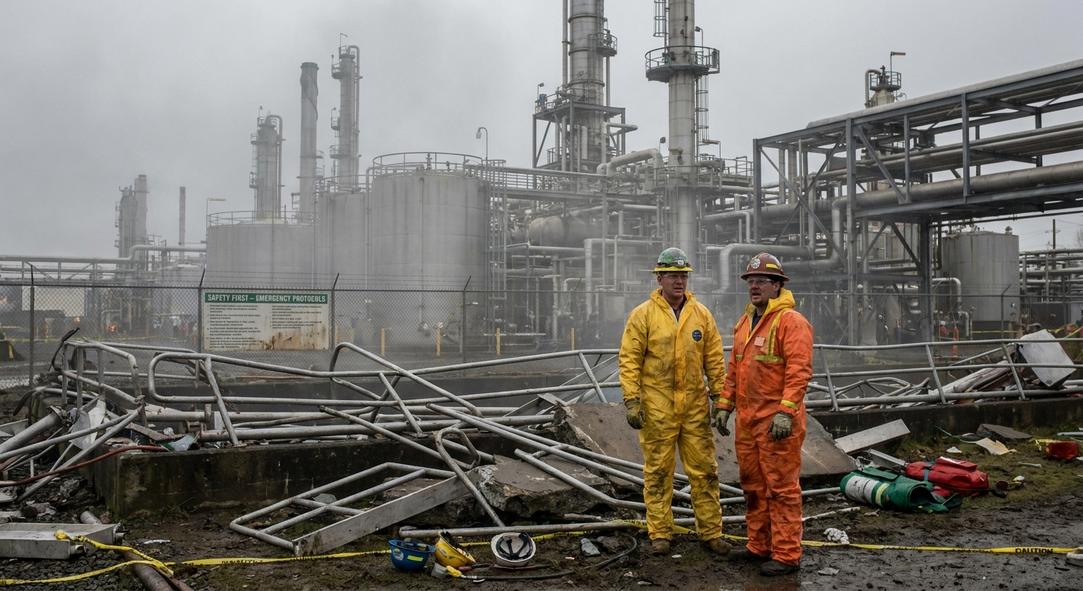
Tragedy Unveiled: The Hidden Ironies of the Washington State Chemical Accident ⚠️🧪
In a world where technological marvels promise ever-greater safety, an invisible enemy proved us wrong in Washington State. The tragic chemical accident—a stark reminder that the line between human brilliance and error is often as thin as a sheet of protective glass, left unscratched in the aftermath of tragedy. In this velvety cloak of modernity, did we overlook the perils lying beneath? 🌐
Irony and Safety: A Tragic Paradox
Oh, the staggering irony that the very safety practices meant to protect lives can sometimes mirror poorly-managed façades. In an age where silicon dictates strategy, a nearly invisible chemical gas streamed through the confines of technology, leaving us aghast and ashamed. How did we come to rely so deeply on systems that now seem to scoff in the face of unforeseen calamity? 💭
Collateral Through Contrast: The Human Element
Eleven lives extinguished in the blink of an eye, like candles snuffed out by an indifferent wind. Those who were embracing life, contributing to society with vigor and hope, lost to a mere oversight or fate’s cruel jest. Each life now a whisper in the halls of a silent industrial grave. The stark antithesis between bright potential and untimely end underlines a narrative oft told in whispers, vibrating with unspoken fear.
How vividly does this human tapestry unravel when confronted with industrial might? The call for rigorous safety now clings to our conscience like a ghost, each reminder casting a long shadow—an incessant whisper for change, even repentance.
Regulation and Reality: A Mismatched Dance
In a world awash with safety regulations—bound neatly in volumes so dense they’re reminiscent of leaden tomes—how does one navigate the gulf between paper rules and lived reality? Like two lovers caught in a mismatched dance, industrial oversight and practical execution seem perpetually out of step. The balancing act atop a precarious precipice, teetering between progress and peril.
- Stringent regulations: Yet loopholes abound, as countless fine prints allow for hazardous blind spots.
- Emphasis on auditing: While genuine intent dilutes through complacency and routine checks.
- Commitment to innovation: Ironically challenged by lag, bureaucracy, and the bittersweet nostalgia for ‘simpler’ times.
Humans, by design, strive to harness the elements, as if nature herself were clay to our sculptor’s intention. Yet, when confronted with the capricious caprices of chemical compounds, our grasp seems tenuous at best, flailing under the weight of physical detachment from tangible hazards.
An Inflection Point for Change?
Is it time for introspection? Must we look beyond the manuals and blueprints scattered on cold factory floors and embrace a holistic evolution in industrial safety? Perhaps the greatest irony lies in our need to return to simpler musings—to understand that human error often succumbs to pride before pragmatism. When will the heart learn to deal with systemic vulnerability?
In the throes of unprecedented technological advancements, with data-driven insights at our fingertips, should we not фен corner ourselves to remember that precision is nothing without empathy, and that safety engineering is incomplete without soul?
As we stand at this inflection point—halfway between past lessons and potential solutions—the recounting of the Washington State incident should nudge us towards a thoughtful re-evaluation. May we ever resist the subtle seduction of convenience over caution, and instill a curriculum of care amidst corridors of commerce?
In this world of iron and oaths, where the very air we breathe now feels silently complicit, perhaps the ripples of this harrowing accident will weave newfound vigilance into our industrial tapestry—one thread of human compassion interlaced with another of learned rigor 🌱⚙️.